
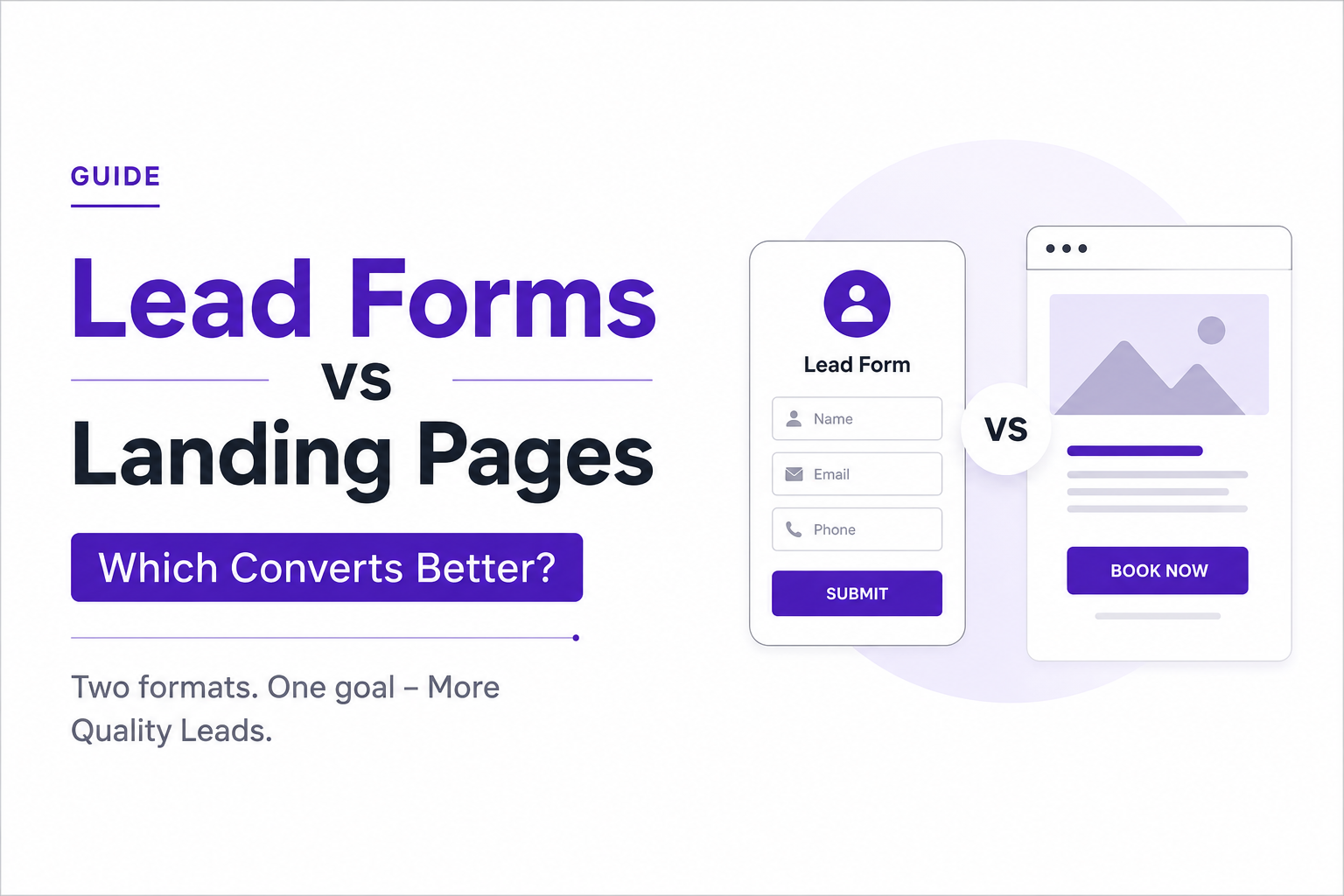
Lead Forms vs Landing Pages - Which Converts Better?
Ask ten marketers this question
and you’ll get ten different answers, mostly because the right answer depends
on what you’re selling, not on which format is “better” in some
abstract sense. A lead form and a landing page both exist to capture contact
details, but the mechanics behind them are different enough that they pull
completely different numbers on cost per lead, form fill rate, and lead
quality. Get the choice wrong for your offer, and the damage shows up two or
three steps downstream, when sales is stuck qualifying a pile of contacts who
were never going to buy.
This blog will explain how each
format actually works, what the data tends to show, and where a real estate
marketing agency, or any business selling something with a long sales cycle,
should draw the line between the two. The goal isn’t to crown a winner. It’s to
help you match the format to the offer, so your cost per acquisition reflects
the quality of leads you’re actually getting, not just the volume.
How Lead Forms Actually Work
A lead form lives inside the platform itself, usually Meta or LinkedIn. The prospect sees an ad, taps it, and a form opens without ever leaving the app. Because the platform already has the user’s name, email, and phone number on file, most fields auto-populate. The person just confirms and submits. From click to conversion, the whole thing can take under ten seconds.
That speed is the entire value proposition. Mobile users abandon forms constantly, not because they lack interest, but because typing an email address on a five-inch screen while riding a train is genuinely annoying. Lead forms remove that friction almost completely, which is why form fill rates on this format often run noticeably higher than on an external landing page for the same offer.
But there’s a mechanical trade-off baked into that convenience: the platform, not you, controls the environment. You can’t add a video walkthrough, a comparison table, or three client testimonials inside a native lead form. You get a headline, a short description, a few custom questions if the platform allows it, and that’s roughly it. So the format works best when the offer doesn’t need much persuading, things like a downloadable price guide, a free valuation, or a webinar sign-up.
Ask for a ₹50 lakh service commitment through a native lead form, and you’ll usually see the fill rate stay decent while the actual lead quality falls off a cliff, because the format never gave the prospect a reason to take the offer seriously.
How Landing Pages Actually Work
A landing page is a page you build and host yourself, designed around a single conversion goal. When someone clicks the ad, they leave the platform and land on a page you control completely, which means you can build the entire case for your offer before you ever ask for contact details.
This matters more than people give it credit for. A landing page can hold a headline that speaks directly to the visitor’s problem, a short video, a handful of testimonials from people who bought the exact thing being advertised, a comparison of before-and-after outcomes, an FAQ section that kills off common objections, and only then, a form. Every one of those elements does a small piece of the persuasion work before the visitor commits to anything. That’s why landing pages tend to out-convert lead forms on offers with real financial or reputational risk attached, the kind where a prospect wants proof before they’ll hand over their phone number.
The cost of that persuasion is friction. Loading an external page takes time, even if it’s under two seconds, and every extra second measurably increases the chance someone bounces before the page even finishes rendering. You’re also asking the visitor to manually type their details rather than tap a pre-filled confirmation, which knocks a real percentage of people out of the funnel who would’ve completed a native form. The upside is that the people who do convert have usually read something, seen some proof, and decided the offer is worth their time. That shows up later as a better lead-to-appointment ratio and a shorter sales cycle for whoever ends up working the lead.
Quick Comparison
|
Metric |
Lead Forms |
Landing Pages |
|
Typical form fill rate |
Higher, often well above external forms |
Lower, drops with each added field |
|
Cost per lead |
Usually lower |
Usually higher |
|
Lead quality |
Mixed, more low-intent submissions |
Stronger, more pre-qualified |
|
Persuasion content available |
Minimal, platform-limited |
Full control: video, proof, FAQs |
|
Load time and bounce risk |
None, stays in-app |
Present, even if small |
|
A/B testing depth |
Limited to headline and image |
Full page, layout, and offer testing |
|
Best fit |
Low-commitment, top-of-funnel offers |
High-commitment, considered purchases |
The table looks balanced, and it should, because neither format is objectively stronger. A free downloadable guide and a ₹4 crore property listing are not the same offer, and treating them the same way at the top of the funnel is where a lot of wasted ad spend comes from.
Where the Trade-Offs Actually Bite
The lead form problem isn’t the format itself, it’s what happens after someone submits. Because the barrier to entry is so low, a chunk of every batch of leads will be people who tapped through out of curiosity, not intent. Sales teams end up building lead scoring models just to sort real prospects from noise, which is extra overhead that a landing page’s built-in friction partially handles for free. That said, for anything low-ticket, list-building, or brand awareness focused, this trade-off barely matters, since the offer never needed heavy convincing to begin with.
The landing page problem is the opposite: real people bounce before they ever see your proof. A slow-loading page, a form asking for too many fields, or a headline that doesn’t match the ad copy can tank conversion rate even when the underlying offer is strong. This is exactly why serious landing page programs run continuous A/B tests, not one-off launches, testing hero images, form length, and headline framing against each other over weeks, not days.
Where Real Estate Actually Draws This Line
Property transactions run on trust and involve a genuinely long sales cycle, often weeks or months between the first click and a signed offer. A real estate marketing agency uses this timeline to decide format on a case-by-case basis rather than picking one tool for everything.
For low-commitment offers, an open house RSVP, a neighborhood market report, or a free home valuation, a lead form performs well. The ask is small, so the missing persuasion content doesn’t cost much, and the speed of a native form usually wins on volume and cost per lead.
For a premium listing, the calculation flips. A landing page built around that one property, complete with a photo gallery, a floor plan, a walkthrough video, and a couple of testimonials from past buyers in that price range, tends to produce fewer but noticeably more serious inquiries. Given that a single closed deal at that price point can be worth tens of thousands in commission, the extra build time and the higher cost per lead are easy to justify.
What Actually Moves the Numbers
- Trim form fields down to what’s genuinely needed for qualification. Every extra field measurably drops completion rate.
- Match the call to action to the offer’s actual value. “Get your free valuation” converts better than a generic “Submit.”
- Use real proof on landing pages, actual client names and outcomes, not vague stock testimonials.
- Run A/B tests continuously, not once. A single test tells you what worked that week, not what works reliably.
- Check mobile load speed specifically, since a majority of real estate ad traffic now arrives from a phone.
- Respond to new leads within minutes where possible. Response time inside the first hour has a well-documented effect on close rate that most funnels still ignore.
To conclude
Lead forms win on speed and cost. Landing pages win on trust and lead quality. The right call depends on the size of the ask, the length of the sales cycle, and how much convincing the offer genuinely needs before someone should hand over their contact details.
If you’re still unsure which fits your business, run both formats against the same offer and compare results past the initial submission, all the way through to appointments booked or deals closed. That’s the only number that actually tells you which format converted better.
