
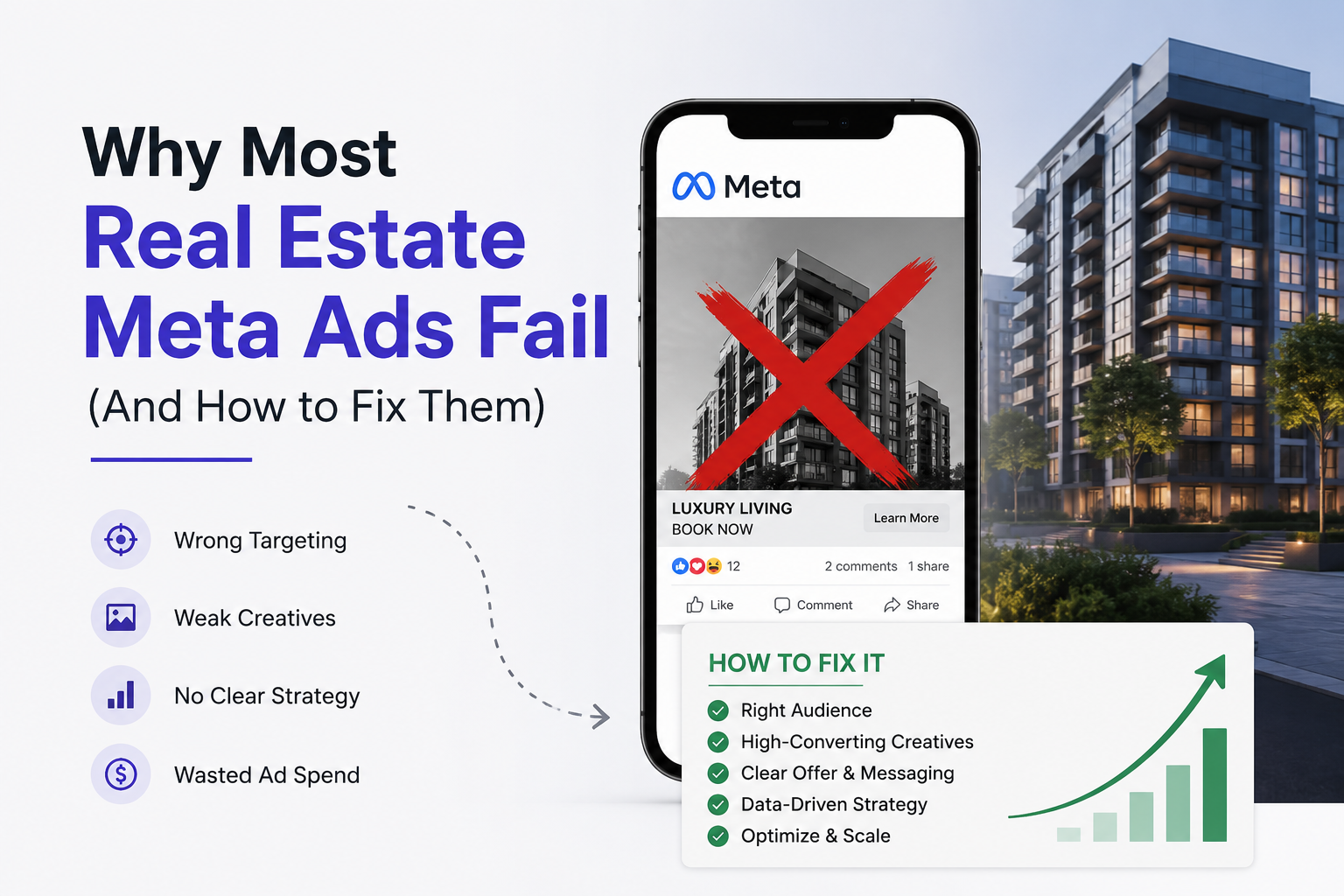
Why Most Real Estate Meta Ads Fail (And How to Fix Them)
Real estate agents spend big money on Meta ads every month, yet most of that money goes to waste. The ads collect likes and comments, but they rarely bring in real buyers or sellers. This usually happens because agents copy generic templates and skip the steps that actually generate leads. A good marketing agency for real estate sees this same pattern almost every time it takes over a new account.
This blog walks through the real reasons Meta ads fail for real estate, and shows you how to fix each one step by step. You don’t need a huge budget to see better results. You need the right strategy, the right message, and a system that follows up on every lead.
Reason 1: The Ad Targets Everyone, Not the Right Buyer
Most real estate ads try to reach everyone in a city, which sounds smart but backfires quickly. Meta’s algorithm ends up spending your budget on random clicks, showing your ad to people who will never buy or sell. As a result, your cost per lead climbs while your lead quality drops.
The fix is to build a narrow audience based on real buyer signals, such as people who searched for homes, moved recently, or follow real estate pages. You can also use lookalike audiences built from your past clients, since this alone can cut your cost per lead in half.
Problem | Fix |
Broad audience targeting | Narrow, intent-based targeting |
No lookalike audience | Build lookalike audiences from past clients |
Same ad for all buyers | Separate ads for buyers, sellers, and investors |
Reason 2: The Offer Is Too Generic
Lines like “Contact us for your dream home” aren’t really an offer, they’re just a slogan, and people scroll right past them. A real estate marketing agency that understands conversion will tell you the same thing every time: your offer needs to solve a real problem, right now.
That means giving people something specific and useful, like a free home value report, a list of new listings, or a mortgage calculator. When your offer is clear, people know exactly what they get by clicking, and specific offers like this convert far better than vague promises ever will.
Reason 3: The Ad Copy Talks About You, Not Them
Many agents write ads that focus on their own achievements, mentioning awards, years of experience, and company size. Buyers and sellers don’t care about any of this at first, because they’re focused on their own problem, like selling fast or finding a safe neighborhood.
That’s why your copy should flip around to start with the reader’s problem instead of your resume. A simple line like “Selling your home can feel stressful. We make it simple.” works better than a list of credentials, which you can save for later in the funnel once trust starts building.
Reason 4: The Landing Page Doesn't Match the Ad
This is one of the biggest silent killers of ad performance, and it’s easy to miss. Someone clicks your ad about new listings, but lands on your homepage instead, where there’s no listing to be found. They feel confused, and within seconds, they leave.
To fix this, give every ad its own landing page, so the headline, image, and offer all match the ad exactly. Keep the page short with one clear action button, since a mismatched landing page can quietly waste over half of your ad budget.
Reason 5: There's No Follow-Up System
Getting a lead is only step one, but most agents forget this and let leads sit in their inbox for days. By the time they respond, the lead has already spoken to three other agents, which shows why speed and consistency matter more than most people think.
The fix is setting up an automatic follow-up system using email and text messages, and responding within five minutes whenever you can. Follow up several times over two weeks instead of just once, since a strong follow-up system can double your conversion rate without spending any extra ad money.
Reason 6: No One Is Tracking the Right Numbers
Many agents only check likes, shares, and comments, and while these numbers feel good, they don’t pay the bills. What actually matters is cost per lead, cost per appointment, and cost per closed deal, because without tracking these, you’re really just guessing in the dark.
That’s why you need simple tracking set up for every stage of your funnel, so you know how many people click, how many become leads, and how many eventually close. Review these numbers every week instead of once a month, so you can cut what isn’t working and grow what is.
Metric | Why It Matters |
Cost per lead | Shows if targeting and offer are efficient |
Cost per appointment | Shows if leads are actually qualified |
Cost per closed deal | Shows true return on ad spend |
Reason 7: The Ads Never Get Tested or Improved
Some agents launch one ad and let it run for months without a second look. The audience gets tired of seeing the same thing, and performance drops slowly until the budget feels wasted. Ads need fresh eyes and regular changes to keep working.
That means testing new headlines, images, and offers every few weeks, then keeping what works and dropping what doesn’t. Even a small change, like a new photo or a shorter headline, can lift results fast, which is why testing should never be treated as optional.
To conclude
Meta ads for real estate don’t fail because the platform is broken. They fail because small, fixable mistakes stack on top of each other until the whole campaign feels like a waste. Fix the targeting, the offer, the copy, and the landing page, then build a real follow-up system behind it all. Once you track the right numbers and keep testing, these changes turn a weak ad into a strong lead machine.
If this feels like a lot to manage alone, that’s completely normal, and it’s exactly why many agents choose to work with a real estate marketing agency. A skilled team can set up your targeting, write sharper copy, build matching landing pages, and manage follow-up for you, which frees up your time to focus on clients and closings while your ad budget finally starts working the way it should.
The bottom line is simple: bad Meta ads are rarely a budget problem, they’re a strategy problem. Fix the strategy, and the results will follow.
